From August 11th to 12th, the Symposium on the High-Quality Development of the Biopharmaceutical Industry in the Yangtze River Delta was held in Shanghai. The symposium was organized by the Office of National Brand Projects of Xinhua News Agency and undertaken by the Xinhua News Agency's Guangdong-Hong Kong-Macao Greater Bay Area Operation Center (Headquarters), Economic Information Daily (Xinhua Health), and Shenzhen Letu Life Science & Technology Investment Co., Ltd. Leaders from Xinhua News Agency, the National Health Commission, the Shanghai Municipal Government, the Shanghai Municipal Health Commission, the Shanghai Food and Drug Administration, the Shanghai Municipal Commission of Economy and Informatization, the Fengxian District Government of Shanghai, as well as industry experts and professionals from biopharmaceutical companies, financial investment institutions, and other sectors gathered together to discuss the path to high-quality development of the biopharmaceutical industry in the Yangtze River Delta, an "Bioeconomic Pilot Zone."
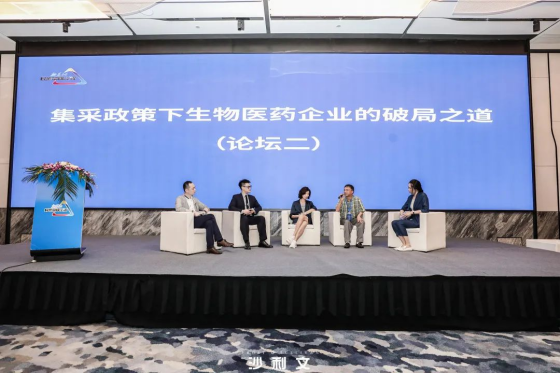
Frost & Sullivanfrost &Chen Zhenrong, the consulting director of Frost & Sullivan's healthcare team in Greater China, was invited to attend a seminar and participate in the fourth session of the Academician Forum at the Letu Watson Lecture Hall. Together with Jin Hui, a partner of Shanghai Guohong Zhizhen Venture Capital Investment Co., Ltd., Wei Dongbing, founder and CEO of Zhongbo Rui Kang (Beijing) Biotechnology Co., Ltd., and Jiang Weidong, CEO of Shanghai Kangkang Biomedical Co., Ltd., they discussed strategies for breaking through under centralized procurement policies for biopharmaceutical companies.

Frost & Sullivan Greater China Healthcare Team Consulting Director Chen Zhenrong
Host: Transformation is an important hurdle faced by generic pharmaceutical companies. Innovative drugs have their own R&D characteristics, and now, with the vigorous development of innovative drugs, the difficulty of developing first-in-class drugs has increased, making generic drug value increasingly low. Innovative drugs are walking on thin ice. How should pharmaceutical companies develop in this situation?
Chen Zhenrong: Indeed, we have encountered many innovative pharmaceutical companies that are pioneering in the field of new drugs. There are many passionate entrepreneurs whose original intention is to introduce the best and latest treatment methods into China to benefit patients.
But as the host mentioned, the country now has a macro background of healthcare cost control through medical insurance, and there is also a demand to reduce patients' medication costs. From the patient's perspective, during the entire medical process, they often encounter situations where treatment costs are difficult to afford. Therefore, many companies, while innovating, also produce generic drugs. Overall, we have noticed that under the centralized procurement policy, many generic drugs have faced significant price discounts.
The development and innovation of new drugs has a long cycle and requires substantial capital investment, which can lead to shortages in research and development expenses for many pharmaceutical companies. In such circumstances, improved new drugs are a relatively good direction, and many enterprises are already developing in this area. There is a saying about the research and development cycle and capital investment of innovative drugs:"Ten billion in ten years," looking at generic drugs, the research and development cycle is about 3 years, with capital investment generally less than $10 million. Modified new drugs are just between these two, with a total research and development cycle of around 8 years, which is relatively shorter. The R&D investment is probably around $50 million, basically below $100 million. Because modified innovative drugs have a solid foundation, they are based on already approved drugs that have been clinically proven to be beneficial. Then, improvements are made to salt form, crystal form, dosage form, and route of administration to improve bioavailability or use smaller doses to reduce drug side effects.
There are some macromolecular drugs and antibody drugs that need to be administered by injection, such as insulin. Patients need to inject them for a long time, which is relatively inconvenient, not to mention some tumor drugs. From the patient's perspective, they hope to see the emergence of improved routes of administration. For example, can insulin be changed from an injection into an oral form? This improvement would be very beneficial to patients. There are also some oral preparations that are not very convenient for cancer patients. For instance, it is very troublesome for patients with digestive tract tumors to take oral medications. We know that if patients have undergone resection of digestive tract tumors, their drug absorption and utilization are very low. We have noticed that some manufacturers have started developing orally disintegrating film agents, which are all good research directions.
In summary, improved new drugs require much less time and money in R&D investment. For pharmaceutical companies, this is a good way to reduce R&D spending while increasing the success rate. Secondly, improved new drugs have the independent right to set their own prices after launch, unlike generic drugs which must maintain the same pricing as the original drug. This means they are not at risk of facing centralized procurement in the near term or even upon launch. Generally speaking, the re-pricing of improved new drugs can be compared to that of generic drugs that have already been reduced in price or have entered the centralized procurement phase.About 5 to 10 times. Therefore, this is indeed a direction worthy of our attention for our enterprise.
On the other hand, improved new drugs place particular emphasis on production work throughout the entire R&D and production process. For companies like Letu Technology, this is especially true.For CDMO, it is very necessary to have closer cooperation. In the early research and development of CMC formulation processes, CDMOs need collaboration from the enterprise side, which allows for mutual assistance and can further bring better drug benefits to Chinese patients.
Host: In addition to pharmaceutical companies that are solely focused on developing innovative drugs, many generic drug companies are also undergoing transformation. Which other niche markets are worth paying attention to?
Chen Zhenrong: We often say that the next era, or a major direction, will definitely involve cell and gene therapiesApplication scenarios of CAR-T (Chimeric Antigen Receptor T-cell Therapy). In recent years, against the backdrop of continuous progress in medical technology and increasingly mature scientific supervision by national policies, the CAR-T industry has developed rapidly. In 2021, China welcomed two commercialized CAR-T products, making CAR-T one of the hottest areas in China's biomedical research and development field.
CGT has many application scenarios. At present, CGT has achieved significant results in the fields of rare diseases and malignant tumors, and is gradually expanding into various disease areas such as chronic diseases and infectious diseases. There are many unmet clinical needs in these disease areas, and the unique advantages of cell therapy are expected to bring long-term efficacy. It is believed that CGT can provide new treatment options for a larger patient population.
In addition, there are new targets and new pharmaceutical directions. The preclinical research of cytokines is also a very important area of focus. As other guests have mentioned, ultimately, the R&D of domestic pharmaceutical companies still depends on their own strength. If they cannot achieve true clinical benefits, whether they will be approved or commercialized in the end is a foreseeable process. This is whyIn the past two years, CDE has released new guidelines for clinical and non-clinical drug trials almost every month, aiming to assist our company in better conducting drug research and development.
There are many experiments that need to be conducted in the early stages of drug research and development. The more experiments are conducted, the more reagents and enzymes are needed. Most of these are still imported, which are very expensive. Therefore, more funds are spent on them. When enterprises carry out the final commercial production, they generally face more headaches because it largely involves"The problem of 'neck pinching'." I believe that this requires the country and its own enterprises to develop domestic kits or overall solutions, which are in great need.
Overall, in the early stages of research and development, target selection requires support from the industry from a commercialization perspective to help solve the problem of high production costs. If the production costs for early-stage research and development are reduced, then the pricing of the drug will also decrease. At the same time, as the prices of national drug centralized procurement tend to become more reasonable, companies are not afraid of facing price cuts or even insolvency after the drug is launched on the market. They are willing to invest more in research and development to bring more affordable good drugs to our country's patients.