Hydrogen energy, as a green energy source, is characterized by wide availability, low carbon emissions, flexibility and efficiency, and diversified applications. Hydrogen has a high energy density and a calorific value much higher than that of fossil fuels. In recent years, hydrogen energy has emerged as a recognized clean energy source, standing out among low-carbon and zero-carbon energies. 12month6Today, Frost & SullivanFrost & SullivanThe online live seminar on 'Hydrogen Energy Industry Review and Outlook in the Zero-Carbon Era', referred to as 'Frost & Sullivan', was successfully held with media support provided by Titanium Media.
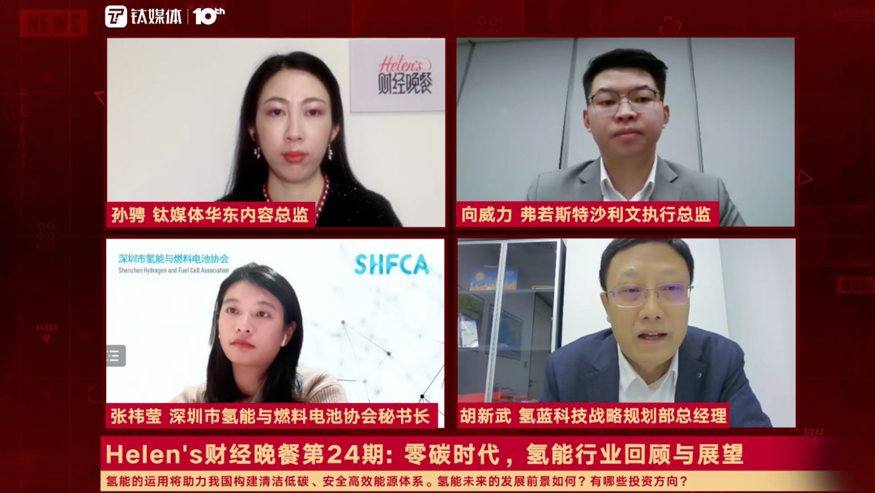
This online live seminar focuses on the main market development trends, technical paths, and industrial chain integration. Xiang Wei, Executive Director of Frost & Sullivan Greater China, joined forces with Zhang Yiying, Secretary-General of the Shenzhen Hydrogen and Fuel Cell Association, and Hu Xinwu, General Manager of the Strategic Planning Department at Hydroblue Technology, to jointly interpret and discuss the current development trends of the hydrogen energy industry. They also gained an in-depth understanding of the latest industry information and the opportunities and challenges the industry faces in the future.
👉Click "Read the Original Text" at the end of the article to watch the live broadcast replay.
1
With strong policy support, the hydrogen energy industry has entered a fast development phase.
2022In [year], Chinese government ministries and local governments introduced a number of policies related to the hydrogen energy sector, covering the upstream 'manufacturing, storage, transportation, processing' four major links, the midstream fuel cell power system field, and the downstream fuel cell vehicle field. The hydrogen energy industry has become a key development area during China's 14th Five-Year Plan period, with an estimated growth rate of2025In China, the number of fuel cell vehicles in use reached5Ten thousand vehicles. Under the goals of carbon peak and carbon neutrality, renewable energy hydrogen production, electrohydrogen coupling, and large-scale application of fuel cells will become one of the powerful approaches for China to build a clean, low-carbon, safe, and efficient energy system.
Q
Sun Cheng, Content Director of Titanium Media East China: The Shenzhen Hydrogen and Fuel Cell Association is a social organization that has taken the lead in focusing on the development, innovation, and utilization of the hydrogen and fuel cell industry. From the perspective of South China, centered around Shenzhen, what are the reasons and significance for the country's strong support for hydrogen energy development?
Hydrogen energy is an important carrier of future energy. It will not only drive the process of 'carbon peak' and 'carbon neutrality', but also systematically change our lifestyle, how we produce energy, and the entire economic system. The Shenzhen Hydrogen and Fuel Cell Association was established2017In [year], the development of hydrogen energy industries in Shenzhen, Foshan, Guangdong, and even across the country was accompanied by advancements. Countries abroad started their hydrogen energy layout earlier, and our country also began paying attention to hydrogen energy very early on, including research and development related to fuel cells and promoting them. However, due to breakthroughs in power battery technology in China and some supportive policies, the development of the hydrogen energy industry slowed down for a period of time. But in recent years, with the proposal of the 'dual carbon' goal, the urgency of energy transformation has become increasingly prominent. At present, the industrialization of some hydrogen energy technologies in China has reached a global leading level, while others are still in a state of catching up.
As hydrogen energy is gradually applied in fields such as transportation and industry, it is expected that the development of the entire industrial chain will also accelerate over time. At the same time, under the policy guidance of demonstration urban clusters, China has basically formed several distinctive regional hydrogen energy industry clusters, including the core regions of Beijing-Tianjin-Hebei, Yangtze River Delta, and Pearl River Delta. Other regions are also exploring their own characteristics and advantages to develop the hydrogen energy industry.
Overall, the hydrogen energy industry chain is long and covers multiple fields, thus requiring cross-industry and cross-regional collaborative efforts upstream and downstream. From the perspective of the association, we are trying to build a professional platform that allows industry participants to join and expand from Shenzhen to other regions, aiming to promote industry exchanges, government-enterprise cooperation, technology promotion, and standardization construction.
Q
Sun Cheng, Content Director of Titanium Media East China: HydroBlue Technology is a leading manufacturer of hydrogen fuel cell systems and core components nationwide. What care and support has the Chinese government, especially the governments of Guangdong Province or Shenzhen City, provided to startups like HydroBlue Technology?
The hydrogen energy industry is in its early stages of development. As practitioners in this field, we have felt over the past two years that from the national level to the governments of Guangdong Province and Shenzhen City, significant policy support has been provided to hydrogen energy enterprises. The state firstTwo batches of urban demonstration clusters have since been promulgated.2021year9In January, the state officially approved the Guangdong urban cluster as one of the first batch of demonstration urban clusters for fuel cell vehicle pilot applications. Since the approval of the demonstration urban cluster, the Guangdong provincial government has formulated a series of support policies for all aspects including hydrogen production, storage, transportation, and utilization. At the same time, the government has provided significant policy support to enterprises in all sectors, whether in terms of investment or costs.
As one of the core cities for hydrogen energy development under the 'dual carbon' goal, Shenzhen has also received policy support in various directions from both the state and provincial government for the hydrogen energy industry, under their overall layout of the hydrogen energy sector.
2021year6In the 14th Five-Year Development Plan of Shenzhen, it is clearly proposed that hydrogen energy and fuel cells will be positioned as key areas for strategic emerging industries for development;2022year6In the 'Opinions of the Shenzhen Municipal People's Government on Developing and Strengthening Strategic Emerging Industries Clusters and Cultivating Future Industries', eight 'key sub-sectors of strategic emerging industries' were proposed, among which key technologies such as hydrogen energy and fuel cells are included in the 'new energy industry cluster'. With the support of these policies, Shenzhen has successively introduced a series of supporting detailed rules ranging from hydrogen fuel cell vehicles to ships, from hydrogen refueling stations to demonstration applications of hydrogen energy storage and distributed power generation.
Q
Sun Cheng, Content Director of Titanium Media East China: From an industry perspective, how do you view the role of policies in promoting the overall development of the hydrogen energy sector?
From an industry perspective, the state has played an important guiding and promoting role in the development of the hydrogen energy sector. For example,2022year3month22On the same day, the National Development and Reform Commission and the National Energy Administration jointly issued the "Medium- and Long-Term Development Plan for the Hydrogen Energy Industry2021 - 2035The document has injected a boost into the development of China's entire hydrogen energy industry. The 'Plan' has clearly elevated hydrogen energy development to the national strategic level, establishing it as an important component of China's future energy architecture and a crucial carrier for green and low-carbon transformation at the energy consumption end. At the same time, the 'Plan' has specified the need to strengthen and support the development of cutting-edge technologies in the hydrogen energy sector, including fuel cell stacks, battery systems, and core components, aiming for domestic substitution.
The policy's promotion of technology is not only in fuel cell vehicles or battery systems, but it is also continuously penetrating into the entire hydrogen production, storage, transportation, and utilization chain, continuously advancing the formation of a closed-loop technology ecosystem for China's hydrogen energy industry. Under the guidance of policies, industry participants have a clear development direction. In the future, the market-oriented operation of hydrogen energy in China will be based on evidence and regulations.
In addition, driven by national policies, a domestic ecosystem has currently been formed3+2The pattern of hydrogen fuel cell vehicle urban demonstration clusters, including2021The annual hydrogen energy development urban clusters in Beijing, Shanghai and Guangdong have taken shape, with a cumulative plan to promote more than210,000 units, with the construction of hydrogen refueling stations exceeding300seat; and2022The addition of Henan and Hebei urban clusters will continue to drive the commercialization and implementation of the hydrogen energy industry. At the same time, the continuous introduction of local policies can further guide the development of enterprises in the hydrogen energy industry chain. The cooperation between the government and enterprises in the hydrogen energy industry chain will deepen, leading to the construction of hydrogen energy characteristic cities and regions.
2
Hydrogen fuel cell vehicles provide important opportunities for the hydrogen energy industry
2022In [year], Chinese government ministries and local governments introduced a number of policies related to the hydrogen energy sector, covering the upstream 'manufacturing, storage, transportation, processing' four major links, the midstream fuel cell power system field, and the downstream fuel cell vehicle field. The hydrogen energy industry has become a key development area during China's 14th Five-Year Plan period, with an estimated to2025In China, the number of fuel cell vehicles in use reached5Ten thousand vehicles. Under the goals of carbon peak and carbon neutrality, renewable energy hydrogen production, electrohydrogen coupling, and large-scale application of fuel cells will become one of the powerful approaches for China to build a clean, low-carbon, safe, and efficient energy system.
Q
Sun Cheng, Content Director of Titanium Media East China: Currently, the hydrogen fuel cell system products produced by HydroBlue Technology have been widely applied in various types of passenger vehicles, trucks, logistics, and other transportation products. So, what are the advantages of hydrogen fuel cell vehicles compared to traditional fuel vehicles and lithium-ion new energy vehicles? What is the current supply and demand relationship for the development of hydrogen fuel cell vehicles?
We know that fuel vehicles consume fossil fuels, producing and emitting carbon dioxide, sulfur dioxide, and nitrogen oxides, which is not conducive to the achievement of the 'dual carbon' goal. Hydrogen fuel cells produce only water through electrochemical reactions, and hydrogen fuel cell vehicles have an advantage over fuel vehicles in terms of cleanliness and environmental protection. In addition, water can be recycled, and further electrolysis of water to produce hydrogen is expected to promote the development of circular economy and zero-carbon economy.
Currently, the development of lithium battery-powered vehicles also has the advantages of being clean and low-carbon. However, hydrogen energy has different power attributes from lithium batteries, thus it possesses some other advantages.
Firstly, hydrogen energy can solve the problem of long battery life for lithium-ion batteries. Hydrogen fuel cell vehicles have lightweight hydrogen cylinders, and a single refueling can support at least400 - 500kilometers of driving. The pressure of hydrogen cylinders currently in use in Chinayes35MPa, which is expected to be adopted in the future as used in Europe, Japan, and South Korea70MPa hydrogen cylinders. In this case, the future cruising range will be further enhanced under the same system.
Second, under the same cruising range, hydrogen fuel cell vehicles have a lighter self-weight than lithium battery vehicles. To increase the range of a lithium battery-powered car, the most direct approach is to continuously add more batteries. Of course, the industry is also constantly researching and developing larger-capacity lithium batteries.
Third, hydrogen fuel cell vehicles have a short refueling time, generally15within a minute. The charging time for lithium batteries is relatively long, and domestic charging stations have not yet met the charging needs of various regions. Especially during holidays, it often takes several hours to charge halfway on highways. Therefore, for China, hydrogen fuel cell vehicles are more suitable for future development, especially for commercial vehicles such as logistics vehicles that are highly sensitive to time.
Q
Sun Cheng, Content Director of Titanium Media East China: From the perspective of the association, what are the current main application scenarios and situations of hydrogen fuel cell vehicles in China? How is the acceptance of hydrogen fuel cell vehicles in South China, represented by Shenzhen, evolving?
At present, the Guangdong Hydrogen Fuel Cell Vehicle Demonstration City Cluster has been established with more than40Number of hydrogen refueling stations, number of fuel cell vehicles promoted3200a vehicle. According to the plan, by2025At the end of the year, the entire Guangdong demonstration urban agglomeration will promote over1Ten thousand hydrogen fuel cell vehicles, with more than200seat.
For major application scenarios, considering that hydrogen fuel cell vehicles have some special advantages, including long-range capability, temperature sensitivity, and refueling speed, overall scenario requirements suggest that downstream industries with demand for long-range capability, those unable to use lithium batteries in low-temperature conditions, and those requiring fast refueling times should be considered. Overall, the main applications of hydrogen fuel cell vehicles nationwide include: vehicles in special scenarios such as ports and mining areas, municipal sanitation vehicles in cities, as well as long-distance commuting, freight, and cold chain logistics vehicles.
As for acceptance, the key influencing factor is the upstream hydrogen supply. Whether the supply of hydrogen can meet the downstream demand is an important aspect of the development of the entire industry. In Guangdong Province, hydrogen is in short supply for fuel cell vehicles. Therefore, the entire province is now focusing on promoting the construction of a hydrogen supply chain system. In addition, another important influencing factor is cost. Currently, hydrogen fuel cells are not very competitive in terms of cost in the market during their initial industrialization phase. However, with the continuous advancement of demonstration applications and future industrial scale-up, costs will further decrease.
We believe that the overall hydrogen energy industry chain will gradually mature. Coupled with technological iteration and cost reduction, hydrogen energy has great market competitiveness and potential in the future.
Q
Sun Cheng, Content Director of Titanium Media East China: The overall penetration rate of hydrogen fuel cell vehicles/What is the current promotion status? What is the outlook for its future development?
Currently, hydrogen fuel cell vehicles are still in the market cultivation phase, with various market indicators at a relatively low level. There is tremendous growth potential ahead. 2021In [year], the number of hydrogen fuel cell vehicles in China was less than1Ten thousand vehicles. Driven by strong policies, coupled with breakthroughs in industrial technology and continuous improvement of hydrogen infrastructure, it is expected that by2026In [year], the sales volume of hydrogen fuel cell vehicles in China will reach nearly1010,000 units,2030The annual sales volume will reach4010,000 units,2022Year to2026The annual compound growth rate for the year is about108%,2027Year to2030The year can still maintain over40%The annual compound growth rate. Meanwhile, the inventory of hydrogen fuel cell vehicles in China is expected to be2025Year-on-year breakthrough1010,000 units, by2030Further breakthroughs in 202110010,000 units.
In terms of vehicle models, hydrogen fuel cell vehicles currently on the market are mainly commercial vehicles, including heavy trucks, light trucks, logistics vehicles, buses, etc. Compared to traditional fuel vehicles and electric vehicles, hydrogen fuel cell vehicles have the advantages of zero emissions, high payload capacity, long range, and fast refueling. With large-scale production and cost reduction, the application scenarios will further expand.
3
Hydrogen energy plans continue to be implemented.
Hydrogen energy storage may become another blockbuster application
With the development of hydrogen fuel cell vehicles, other applications related to hydrogen energy are gradually attracting market attention, such as hydrogen energy storage. Hydrogen energy storage technology utilizes electricity-hydrogen-It has developed based on the interconversion of electricity. By electrolyzing water to produce hydrogen, it converts electrical energy from renewable sources into hydrogen energy for storage, aiming to achieve energy distribution, optimization, and integration. It has advantages such as cross-seasonal, cross-regional capabilities, rapid response, and large-scale storage.
Q
Sun Cheng, Content Director of Titanium Media East China: Based on the information held by the association, what is the current development status of hydrogen energy storage in Shenzhen or other regions? Are there any related demonstration projects? In addition, what are the association's plans or support for the hydrogen energy storage field?
Hydrogen energy storage is definitely an important development direction for hydrogen energy in the future. For this large amount of stored energy, hydrogen energy storage will be more used for cross-regional and cross-temporal storage of renewable energy.
Guangdong is a major electricity-consuming province, and many enterprises have already started to gradually develop technologies in this field. However, the application of hydrogen energy storage is not yet mature and requires further development. For example, in the planning of urban demonstration clusters, Yangjiang City is included to promote the development of offshore wind power in Yangjiang, thereby using excess power that cannot be consumed locally for preliminary demonstration projects of hydrogen energy storage. Another example is Foshan City, which has already begun using hydrogen energy in residential buildings, such as fixed hydrogen energy storage power generation and cogeneration demonstration projects. Nationally, Shandong has the initiative 'Hydrogen into Ten Thousand Homes,' and the three northeastern provinces have carried out many large-scale renewable energy storage projects involving wind, solar, and hydrogen energy storage. The above are currently the larger-scale or more mature projects in progress.
From the perspective of enterprises, for instance, in Shenzhen, Hydrogen Blue Era or Chaozhou Third Ring has made arrangements for the development of stationary power generation fuel cell systems and related products. In the future, hydrogen energy storage will have a very good downstream consumption direction.
From the perspective of the association, we are actively engaging with other industry organizations and regions for exchanges and cooperation. At the same time, we have also established good connections and communications with some regional governments and places where renewable energy such as wind, light, and water is relatively abundant. We hope to combine our advantageous products with local renewable energy resources to form cross-regional industrial chain cooperation. These are areas that the association hopes to further promote in the future, namely, collaborative cooperation between upstream and downstream industries.
Q
Sun Cheng, Content Director of Titanium Media East China: From the company's perspective, how does it view hydrogen energy storage and its operational model? What specific role does it play in further promoting the development of the hydrogen fuel cell industry?
this year3In the month, the National Energy Administration announced its hydrogen energy development plan, which for the first time clarified the attribute of hydrogen as an energy source. According to the requirements of 'carbon peak' and 'carbon neutrality', hydrogen and electricity are the core and most important energy sources in the future consumer sector. Global forecasts suggest that the EU believes that by2050Hydrogen energy will account for24%, the United States will reach18%, We predict that2050In China, it will reach about10%Regardless of the final proportion, it is equivalent to the current proportion of oil in global energy consumption.
From the perspective of enterprises, we just mentioned two dimensions: cross-seasonality and cross-regionality. Why is there cross-seasonality? Take hydropower as an example; there is a seasonal mismatch in energy supply and demand for hydropower, and hydrogen energy storage technology can improve or even change the nature of this problem. For instance, using some caves or pits for large-scale hydrogen storage, during the summer when floods come, hydrogen can be produced by electrolyzing water and stored. When the dry winter season arrives, it can supply hydrogen, thus solving such problems in the long run. Large-scale hydroelectric matching applications are the medium- to long-term goal for the future.
In addition to cross-seasonality, there is also cross-regionality. China's energy sources, whether in the form of minerals, coal, or electricity, are mainly located in the northwest region, while the usage centers are on the southeast coast. Currently, our storage technology is primarily gaseous, but in the next three to five years, liquid hydrogen storage technology will be further innovated to promote cost reductions. Whether it is the long-distance transportation of liquid hydrogen through pipelines or the less costly method of shipping hydrogen to the southeast coast by sea, these methods will surely be promoted in the future.
Cross-regional energy storage has many demonstration scenarios in the power, industrial, transportation, and construction sectors. For example, the hydrogen blue plant in Shenzhen Bay, also known as the Western Hydrogen Energy Demonstration Post, is dedicated to the integrated construction of hydrogen production, storage, and refueling. After completion, it will adjust peak and off-peak usage by taking advantage of the growing price difference between peak and off-peak electricity. For instance, hydrogen can be produced at night using off-peak electricity for use during the peak hours the next day. In regions like Xinjiang and Inner Mongolia, which are extremely rich in wind and solar resources, the electricity generated can be converted into hydrogen. On one hand, hydrogen can be used in the local transportation sector as a fuel alternative to crude oil, including heavy trucks and other vehicles used in logistics transportation. On the other hand, it can also meet the needs of wind, solar, and peak shaving.
Q
Sun Cheng, Content Director of Titanium Media East China: Compared to current different energy storage technologies, what are the characteristics of hydrogen energy storage? What are the main advantages of hydrogen energy storage?
According to different forms of energy, energy storage can be divided into:1)Electric energy storage, which includes mechanical energy storage, electrochemical energy storage, and electromagnetic energy storage;2Thermal energy storage can be understood as using thermal storage materials as a medium to store solar photothermal, geothermal, and industrial waste heat, which is then released when needed; and3Hydrogen energy storage, which uses hydrogen as a medium or carrier, involves first producing hydrogen through electrolysis of water for storage. When needed, energy is released through a hydrogen fuel cell system. Both electric energy storage and thermal energy storage share common shortcomings, including short charging and discharging cycles, almost limited local use, capacity limitations, and being affected by seasons.
In comparison, hydrogen energy storage has several clear advantages. The first is new energy consumption management; storing unused electricity can reduce costs due to economies of scale, and it is zero-polluting.
Hydrogen energy storage typically employs various methods such as long-tube trailers and pipeline hydrogen transportation, offering a more flexible storage and transportation approach without geographical limitations. Hydrogen energy storage can be optimized independently in terms of power and energy, with the processes of electricity storage and generation proceeding simultaneously. In the future construction of large-scale energy storage stations, hydrogen energy storage has significant advantages and is expected to become an important means of grid peak shaving.
4
The industrial chain is taking initial shape, and the urban cluster effect is evident.
In addition to the application of hydrogen energy, the layout of hydrogen energy industry clusters has also attracted much attention. Currently, hydrogen energy development in China is in the stage of industrial introduction, and applications in various fields are experiencing '0reach1During the breakthrough period, various regions have successively released plans for hydrogen energy development and related applications, and the number of companies participating in the hydrogen energy sector has also been rapidly increasing.
Q
Sun Cheng, Content Director of Titanium Media East China: What is the current and future industrial base layout of HydroBlue Technology in China? What role do these layouts play in the construction of local hydrogen energy industry clusters?
Hydroblue Self2018Since its establishment in 2019, centered on Shenzhen and deeply involved in the Greater Bay Area, HyBlue has played a very important role in promoting hydrogen energy development industry planning, application scenario implementation, and the construction of the hydrogen supply chain. With the support of the Shenzhen Municipal Government, we are building a headquarters base R&D center, testing center, and some production bases in Shenzhen. At the same time, we are deploying power stack production bases in Guangzhou within the Greater Bay Area, considering deploying hydrogen fuel cell systems in Dongguan, and collaborating with upstream and downstream partners such as vehicle manufacturers in Zhongshan. Therefore, Hydrogen Blue is a leading enterprise within the Greater Bay Area industrial cluster, dedicated to collaborating with upstream and downstream industries to leverage the advantages of hydrogen fuel cells. At the same time, with Shanghai as the core base for radiating the Yangtze River Delta region, some of the R&D and production bases for emerging businesses have moved into the Shanghai Hydrogen Energy International Intelligent Industrial Park. Additionally, we have layouts in Beijing, Handan, Hebei, and Henan.
At present, Hydrogen Blue is more focused on electricity-hydrogen and hydrogen-Electricity, combined with China's energy characteristics, the energy storage sector is defined as an emerging market. This year5In a certain month, HydroBlue signed a strategic cooperation agreement on the potential for joint hydrogen energy development with a state-owned enterprise in Shenzhen and the Xinjiang Autonomous Region government. Subsequently, it gradually expanded its efforts in Inner Mongolia, Jinzhou in Liaoning Province, and other regions, making early arrangements in emerging markets by combining local characteristics. I often assist cities that are not part of the demonstration city cluster in developing new energy industry plans, prioritizing planning over implementation. I hope that these emerging markets2 - 3After the Spring Festival, it became a demonstration city and gradually brought the development of hydrogen energy across the country onto an accelerated track.
In addition to the domestic market, HydroBlue also looks towards foreign markets. On one hand, it learns from the advanced European and American markets, as well as Japan and South Korea, drawing on their experiences. At the same time, we are confident that following the development trends of these two years, HydroBlue will soon reach a leading level. On the other hand, HydroBlue has also developed rapidly in some developed markets such as Southeast Asia and Africa, and is considering entering emerging markets like the Middle East and West Asia.
Q
Sun Cheng, Content Director of Titanium Media East China: What measures will the association take to continuously promote the establishment and penetration of hydrogen energy local industrial clusters?
According to the association's statistics, there are now more than120Enterprises related to the upstream and downstream of the home industry chain are deploying in the fuel cell sector, among which more than40%We conduct business in the fuel cell system, battery stack, and related materials sector.30%The company operates in the fields related to hydrogen production, storage, and transportation.
Our association first focuses on Shenzhen, integrating resources from upstream and downstream of the industrial chain to further enhance interaction among enterprises. Regionally, in Guangdong Province, we have relatively close cooperative relationships with cities such as Foshan, Guangzhou, and Zhongshan, especially this year10In the month of [date], we conducted strategic cooperation intentions communication with Zhongshan Cuiheng New Area, which will facilitate the establishment of a hydrogen energy industry alliance for Zhongshan.
Nationwide, we also have relatively close cooperation with cities such as Shanghai, Beijing, Sichuan, and Dalian. Additionally, at the national level, the China Hydrogen Energy Alliance holds monthly consultations to facilitate information exchange within the industrial chain and further promote regional cooperation. I believe that whether it is from the perspective of the industrial chain or region, our association hopes to continue to play a catalytic role in the construction and exchange of these platforms as always.
Q
Sun Cheng, Content Director of Titanium Media East China: Looking at the current development status of the hydrogen energy industry, what are the main development characteristics and trends of hydrogen energy industrial clusters across the country?
2020In [year], five ministries and commissions jointly issued the 'Notice on Carrying Out Demonstration Applications of Fuel Cell Vehicles', initiating the demonstration application promotion of fuel cell vehicle urban clusters across the country for the hydrogen energy industry cluster.
The main characteristics of the hydrogen energy industry's industrial clusters include:1Urban hydrogen energy development exhibits a clear spatial agglomeration effect, mainly concentrated in the Yangtze River Delta urban cluster, Beijing-Tianjin-Hebei urban cluster, Guangdong-Hong Kong-Macao Greater Bay Area, and the middle reaches of the Yangtze River; hydrogen energy industrial clusters in Henan and Hebei will also gradually take shape, radiating to surrounding provinces.; 2)Each city has its own advantages in different dimensions of hydrogen energy development. By coordinating and collaborating within and between urban clusters, complementary strengths can be realized to promote the common development of industries.
Urban clusters are the result of policy promotion and an important step towards the industrialization, commercialization, and ultimately market-oriented operation of the hydrogen energy industry. China's future hydrogen energy industry clusters will pay more attention to a global perspective and international standards, building a full-linkage, three-dimensional hydrogen energy industry architecture.
5
The industry has begun to show initial results,
In the future, it will move towards diversified and three-dimensional development.
Sun Cheng, Content Director of Titanium Media East China: Regarding the supporting infrastructure for hydrogen energy, what challenges and countermeasures will there be in the construction and operation of hydrogen refueling stations in the future?
The construction of hydrogen stations involves the approval of relevant competent authorities, so there are indeed some difficulties in terms of policy formulation and related support. Currently, it is quite difficult to find the relevant authorities during the construction of many hydrogen refueling stations. However, in regions like Shanghai and Foshan, which are leading in hydrogen energy development in China, the relevant governments have taken the lead in introducing management measures for the construction and operation of hydrogen refueling stations. Based on the experience of these cities, Shenzhen in Guangdong Province will also gradually issue corresponding support policies.
In addition to the approval process, hydrogen stations still face difficulties in cost control in the future. Because cost means how to make hydrogen fuel vehicles as economical as, or even cheaper than, conventional fuel vehicles. This pressure actually falls on the operation of hydrogen refueling stations, including the price of upstream hydrogen and the costs of storage and transportation.
Q
Sun Cheng, Content Director of Titanium Media East China: Regarding the technical R&D direction of hydrogen energy, what are the current achievements of HydroBlue Technology in this area? What are the key areas that deserve attention and breakthroughs in the future?
Since its establishment, HydroBlue has been adhering to a proactive R&D strategy. This proactive R&D strategy means that the proportion of R&D personnel in a startup always exceeds50%Currently, the company has formed a series of products in the automotive sector through four years of continuous R&D investment. Starting this year, it has further delved into fields such as power, shipbuilding, and unmanned aerial vehicles, forming a layout covering sea, land, and air. As a company focusing on systems and stacks in the fuel cell and hydrogen energy industries, on one hand, we continue to increase investment in research and development, adhering toTFormulate development strategies, deeply explore core technologies and independent innovation vertically, expand products horizontally, and enhance customer experience.
In addition, regarding the issue of costs, I think it mainly comes from2Solve at each level. The first is the localization substitution, from upstream materials to core components in the middle, and then to the final system for localization replacement. The second is large-scale production; any industry can only see cost reductions when there is a certain level of mass production. Of course, we also hope that the government can play a greater role in the overall supply chain system, including hydrogen refueling stations, hydrogen production processes, and infrastructure construction, providing more policy support. After the establishment of the overall supply chain system, by matching excellent technologies to produce high-quality products, coupled with extensive promotion of application scenarios, the dual carbon and hydrogen energy strategies can truly be realized faster and better.
Q
Sun Cheng, Content Director of Titanium Media East China: In terms of industry commercialization and promotion, what challenges do you think we will still face? How should the entire industry work together to face these challenges and promote the future development of the industry?
Driven by strong national policies and continuous efforts from enterprises within the industry, the development of hydrogen energy in China has begun to show initial results. However, the industry still has a long way to go. The commercial implementation of the hydrogen energy industry cannot be determined by a single link; it requires the joint progress of the entire hydrogen production, storage, transportation, and utilization chain to achieve. Of course, the hydrogen sector has made tremendous progress in the fuel cell and fuel cell vehicle industry, but we have also noticed that some challenges in other processes are being continuously overcome.
For example, most existing hydrogen production technologies rely on primary fossil fuels such as coal to produce 'grey hydrogen' (global hydrogen production90%As mentioned above, economic and environmental issues remain prominent. The global development trend of hydrogen production is shifting from 'grey hydrogen' to 'blue hydrogen' (produced by steam methane reforming or self-heating steam reforming of natural gas, combined with carbon capture, storage, and utilization technologies, which also emit greenhouse gases but are controllable) and 'green hydrogen' (hydrogen produced from renewable energy). In terms of green hydrogen, the use of renewable energy such as solar or wind power...The production of hydrogen from renewable energy still faces issues such as low efficiency and high comprehensive costs. The 'greening' of hydrogen is an industry challenge and a direction for future corporate efforts.
Additionally, in the hydrogen utilization sector, the current ownership of fuel cell vehicles is still at a decreasing level. There is hope for a surge in the future, but in the initial phase, due to significant R&D investment and capacity planning, there has been less volume increase, resulting in continuous losses. This is the main challenge faced by companies within the industry at present. Of course, the government is continuously providing various industrial policy supports, including tax and subsidy measures. In the future, scaling up is expected to reduce costs, similar to the development of the electric vehicle industry today.
As hydrogen energy is positioned as a national strategic direction, a series of supportive policies will continue to be introduced to promote the industry's development. There will also be more capital flowing in, accelerating R&D, production, and commercialization of upstream and downstream enterprises in the industrial chain. In the future5 - 10Great changes can be seen in just one year. Fuel cell vehicles will continue to be the largest carrier of hydrogen energy at the end-user level in the future. However, more diversified scenarios will emerge, including mobile rail transit, ships, or fixed power generation and hydrogen energy storage. Fuel cell stack and battery system companies will gradually shift from the transportation application field to becoming fuel cell equipment manufacturers and solution providers.
In the future, with continuous technological upgrades, the rise of domestic substitution, the integration of leading enterprises' industrial chains, and the refined division of labor in the industry, market diversification and three-dimensional development will be further promoted.
👉Click "Read the Original Text" at the end of the article to watch the live broadcast replay.