2023Global Digital Commerce Conference
11month25day-26On2023The Global Digital Commerce Conference was successfully held in Shanghai.
The theme of this conference is “Digital Connectivity for Global Commerce, Future-Proof Business ” Delve into key topics related to data elements, offering suggestions for the construction of the data element market. This includes discussions on the development and utilization of public data, compliant data circulation, cross-border data flows, infrastructure construction for data circulation, international data space development, development of the digital commerce ecosystem, interconnectivity of data element trading markets, innovation in data assetization, and industrial applications of data elements.

Frost & SullivanFrost & SullivanWang Chenhui, Partner-in-Chief and President of Frost & Sullivan Greater China, Co-founder and President of LeadLeo, was invited as an awarding guest to attend the 'Digital Commerce Night'. And was invited to “2023He delivered a speech titled "Global and Chinese Data Trading Market Research and Analysis Report" and shared his thoughts and insights on the data trading market with the attending guests.

Managing Partner and President of Frost & Sullivan Greater China, Co-founder and President of LeadLeo Wang Chenhui
Wang Chenhui stated that the data trading market is an emerging and rapidly developing field, which stems from the advent of the digital age and the continuous popularization of big data technology. In today's digital age, data has become an important asset for businesses and individuals, and data trading has become a crucial part of this new economic sector. In this market, businesses and individuals can buy and sell various types of data, including consumer data, enterprise data, financial data, and more. These data not only possess extremely high commercial value but also have a profound impact on social and economic development.
At the same time, with the continuous acceleration of the digitalization process, data has become an important basis for corporate and individual decision-making. The data trading market provides enterprises with access to high-quality data resources and also offers individuals a way to realize the value of their data. Through data trading, enterprises can better understand market and user needs, optimize products and services, improve efficiency and reduce costs. Individuals can generate economic benefits by selling their data and also obtain better services and products. According to the predictions of Frost & Sullivan and LeadLeo, by2025In [a certain year], the global data trading market will reach1,445billion dollars;2030The annual market scale will reach3,011billions of dollars. This figure is sufficient to illustrate the importance and potential of the data trading market.
Core viewpoints
Wang Chenhui believes that China has entered a new stage of integrated development between the digital economy and the real economy. As data elements, as a new type of production factor, empower the development of other traditional production factors in all aspects, transactions targeting data products have been carried out, further deepening the development of China's digital economy. With the introduction of a series of policies for data elements, the innovative vitality of data elements has been further stimulated, promoting the rapid development of the data element market, and data transactions have seen a new wave of development.
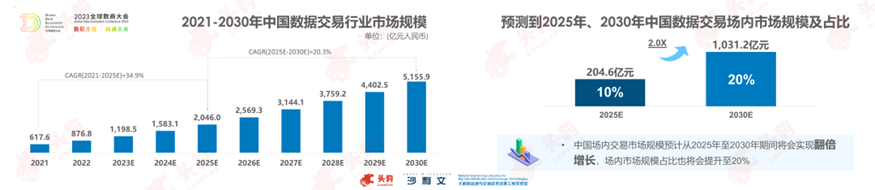
He further pointed out that in the future, there is still considerable market growth potential for China's data trading industry. It is expected that the market scale of China's data industry will continue to show a steady growth trend in the future, and2025The market scale of China's data industry is expected to reach2,046.0yuan, to2030The market scale of China's data industry is expected to reach5,155.9yuan,2025 - 2030The annual compound growth rate is about20.3%. In the next decade, the annual compound growth rate of the scale of China's data trading market will be much higher than that of the global data trading market.CAGRhorizontal.
The Chinese data trading market can currently be divided into two parts: intraday trading and over-the-counter trading. With the development of China's data trading industry, the market share of intraday trading in China will continue to rise. At the same time, more and more Chinese data exchanges have been established, and data trading activities are migrating towards intraday trading venues. As important platforms of the data market, these exchanges provide a more standardized, transparent, and efficient trading environment for both data supply and demand sides. Through intraday trading, the quality and security of data are better guaranteed, and it also promotes the optimal allocation of data resources and maximizes their value. In the future, with the continuous expansion and improvement of the data trading market, we have reason to believe that this will inject stronger momentum into China's digital transformation and economic development.
In summary, The Chinese data trading market will continue to migrate towards on-exchange trading. In the future, off-exchange trading will align with the regulatory rules for on-exchange trading, the quality of data products, and the business models of outstanding data merchants, aiming to achieve the 'three good goals' of good enterprises, good products, and good services.

Global data trading
Next, Wang Chenhui will look at the data trading market from a more quantitative perspective, starting with the global market.
As the digitalization process accelerates in various countries, data has become a new factor of production, and the scale of data transactions has also been growing continuously. 2022The global data transaction volume is currently at approximately906billion US dollars, forecast to2025The annual market size is expected to grow by more than one trillion US dollars, and the global market will continue to grow steadily in the future.2030The global data trading market size is expected to reach3,011billion dollars.
Wang Chenhui pointed out that the main reasons for the expansion of the global data trading industry market size include three points: First, the development of the data trading market is inseparable from the development of the data economy and policies. Countries have put forward various terms regarding data pricing, trading mechanisms, and rights confirmation. The improvement of policies has promoted the development of the global data trading market; second, with further economic globalization, the number of multinational enterprises has climbed, and the demand for cross-border data products and services trading has been continuously increasing, leading to an expansion in the data trading market size; third,2020In the year, sudden emergencies erupted, offline real economy was restricted, and most goods and services began to shift online, accelerating digital transformation. The scale of data transactions increased.
2022The market size of the U.S. data trading market in 2019 was417Billions of dollars, the United States is the country with the largest global data trading market size. The main reasons for the growth in the US market size are as follows: Firstly, the United States is an absolute advantage country in North America, with its total economic volume and economic growth rate far exceeding those of other countries. The proportion of the digital economy exceedsGDPtotal value60%Secondly, the leading data trading companies in the United States are all internet enterprises, which span the globe and possess strong capabilities, giving the US data trading industry a unique data foundation and technological advantage.

China Data Trading
Wang Chenhui believes that China's prominence in the global market is due to the support of the policy and economic environment. The data trading industry in China has experienced rapid growth over the past two years.2021 - 2022In China, the market scale of data trading industry in600RMB 10 billion, increasing to over800yuan, with an annual growth rate of about42.0%The growth rate has been significantly accelerating. Considering the favorable factors such as the industry development stage and policy environment, it is expected that in the future3 - 5During the year, China's data trading market will still be able to maintain relatively high-speed growth.2025The market scale is expected to grow to2,000Above 100 million yuan, with a still relatively high growth rate.
At the current stage, the main reason for the expansion of the market scale of China's data trading industry lies in the gradual prominence of data value. The state strongly advocates and supports the development of the digital economy, and data has become an important basic and strategic resource for countries in today's era.
In the future, there is still considerable market growth potential for China's data trading industry. It is expected that the market scale of China's data industry will continue to show a steady growth trend in the future, and2030The market scale of China's data industry is expected to reach5,000Yuan billion, with the overall growth rate of the Chinese market significantly higher than that of the global market.
Then, Wang Chenhui stated that as the Chinese data trading market grows, the market share of on-exchange transactions in the industry is also continuously increasing.2025The annual target is expected to be reached10%,2030Annual meeting achieved20%, achieving a doubling of growth.
In the future, the data trading market will continue to develop towards on-exchange activities. There are four reasons behind this: Firstly, on-exchange trading brings together high-quality enterprises, providing a high-quality endorsement for data trading enterprises. Secondly, the data products traded on-exchange have relatively strict quality standards, and the state will also introduce corresponding pricing standards in the future to regulate the products traded on-exchange. At the same time, on-exchange trading has established trading rules to ensure the safety of the trading process and provide good services for both parties involved in transactions. Finally, transferring data trading to on-exchange can offer enterprises more diversified data trading methods, including the confirmation, trading, circulation, and monetization of data assets. Through the on-exchange trading market, enterprises can invest and operate data as assets, tap into more potential value of data, and realize the assetization of data.
In summary, the establishment and development of an in-market trading platform can promote the optimal allocation of data resources and maximize their value, enabling data to truly become digital assets and assist Chinese enterprises in their development.
Data trading across regions
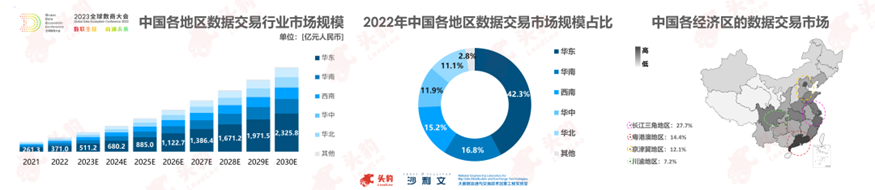
Wang Chenhui introduced that the regions with the largest market scale for data trading in China are East China and South China, followed by Southwest China. This figure is directly related to the development of digital economy in each region.
Overall, the reasons for the better development of data trading markets in East China, South China, and Southwest China are as follows: First, the financial markets in East China and South China are well-developed. Since the demand side for data is mainly concentrated in the financial industry, such as securities firms, insurance companies, banks, etc., the development of the financial industry in East China is relatively concentrated, thus leading to better development of the data trading industry. Second, the internet industry in East China and South China is also well-developed. Since internet companies lay the technical, software, and hardware foundations for data trading markets, the data trading markets in East China and South China developed earlier and have a solid foundation from multiple aspects. Finally, for Southwest China, its data center infrastructure is relatively complete, and the data trading scale of the Guiyang Data Exchange is leading in the market, so the development of the data trading market in Southwest China is also relatively stable.
He stated that the market scale of data trading in the Northeast and Northwest regions is relatively low, mainly due to economic and demographic limitations, which have led to significantly insufficient production and sales of data trading in these two markets.
Looking at the main economic regions, data trading is mainly concentrated in the Yangtze River Delta region, accounting for nearly30%Secondly, the data trading market in the Guangdong-Hong Kong-Macao region has also developed quite strongly, followed by the Sichuan-Chongqing region. Looking at each city, the top ten cities with better development are Guangdong, Beijing, Shanghai, Zhejiang, Jiangsu, Fujian, Shandong, Sichuan, Hubei, and Henan.
Overall, all regions are actively exploring and promoting the development of data trading markets. Some regions have adopted the method of establishing public data platforms to promote the open sharing of government data; others have provided data trading services for enterprises by establishing data trading centers or platforms. In the process of development, all regions also face some challenges and problems, such as low data quality, insufficient data security guarantees, and a lack of unified data trading rules and standards. To solve these problems, all regions need to further strengthen policy support, technology research and development, talent cultivation, and other aspects to promote the healthy development of the data trading market.
At the same time, with the continuous development of the digital economy, the data trading market will also face more opportunities and challenges. Regions need to closely monitor market changes and policy trends, strengthen cooperation and exchanges, and jointly promote the prosperous development of the national data trading market.
Data trading across industries
Wang Chenhui believes that the data element market is a comprehensive factor market that spans various fields, with a rich variety of scenarios for the application of data resources in China. In recent years, the demand for data applications across all industries has been continuously increasing, which has also significantly promoted the activity of China's data trading market.2022In [year], China's data trading scale exceeded800RMB 10 billion. Among them, according to the data application fields, the data transaction scale of the financial industry is about300Yuan, with the scale accounting for35.0%It is currently the largest sub-industry data trading market. Since data is a core element in financial operations and plays a very important role in financial risk control and marketing, data products are used more extensively and intensively in the financial industry than in other sectors. Banks, insurance companies, securities firms, and some internet companies are currently the core users of financial data.
As the largest sub-industry of data application, the financial industry has diversified data sources, including operators, social security, industry and commerce, insurance, power, medical insurance, etc. The data providers are mainly represented by state-owned enterprises. In terms of data product types, credit reporting products are the most significant transaction products in the financial industry, including personal credit reporting and corporate credit reporting. Among them, the transaction scale of personal credit reporting data products can account for nearly26.0%.
Subsequently, he stated that the data trading market in the financial industry has shown a rapid growth trend over the past five years and has considerable room for growth in the future. If policies can actively promote the development of data rights confirmation, data classification, and the inclusion of data assets in financial statements, and if the openness of public data can continue to deepen the application scenarios of financial data, then businesses with great potential, including financial customer profiling, credit lending, joint credit reporting, and financial anti-fraud, will be further developed.
In addition to the financial sector, data trading in the internet industry is the second largest data application industry, accounting for approximately24.0%The proportion of data trading in the communication industry has also reached about9.0%The data trading volume in manufacturing, government affairs, and healthcare industries is comparable, each accounting for a portion of the overall market6.0%-7.0%market share; approximately8.0%The market scale of data trading is dominated by other industries, such as culture and tourism, agriculture, etc. In the future, with the promotion of favorable policies related to data rights confirmation, data classification, and data assets like tables, the application value of various data products in various industries is expected to continue to be developed, and the trading scale will continue to increase.
Finally, Wang Chenhui pointed out that with the in-depth development of the digital economy and the improvement of informatization levels, China's data trading market will embrace broader development prospects. At the same time, it also requires the joint efforts of all sectors to strengthen cooperation and innovation, promote the standardization, normalization, and innovation of the market, and achieve rapid development of the digital economy. We look forward to further development of China's data trading market!