Finance China2023Annual Meeting and21Current Financial and Economic Storm Chart
12month12On the same day, Financial China, co-hosted by Hexun Network and Lianban Group2023Annual Meeting and21The session of the Financial & Economic Outlook & Banking Forum was successfully held in Beijing. The conference theme was "Upholding Integrity and Innovating Advanced High Quality" as the theme.
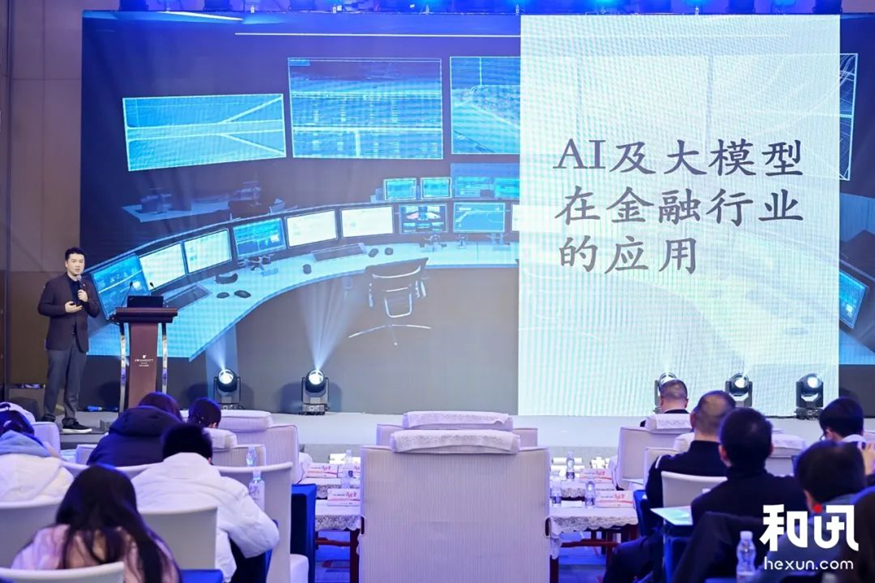
Frost & SullivanFrost & SullivanWang Chenhui, Partner-in-Chief and President of Frost & Sullivan Greater China, was invited to attend the meeting and delivered a keynote speech titled 'Insight into the Future Development Trends of Financial New Technologies'.
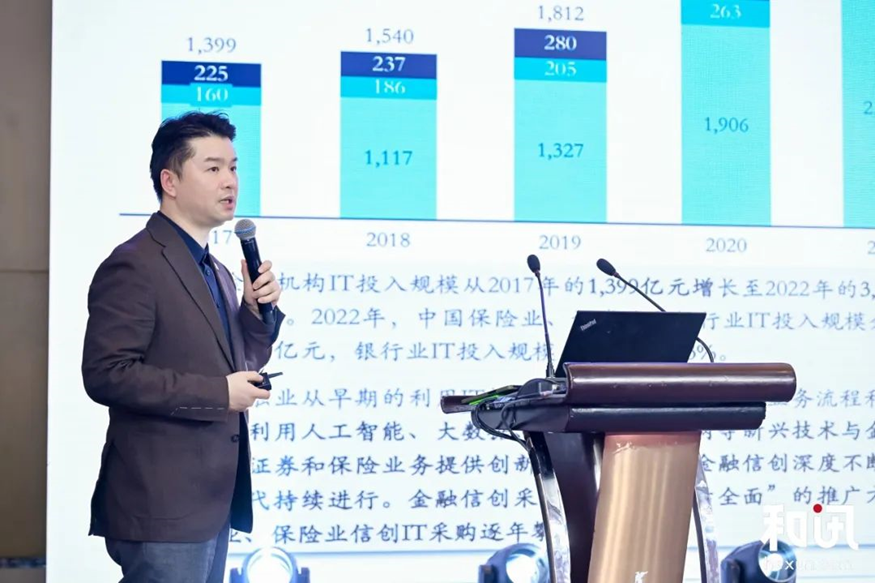
Managing Partner and President of Frost & Sullivan Greater China Region Wang Chenhui
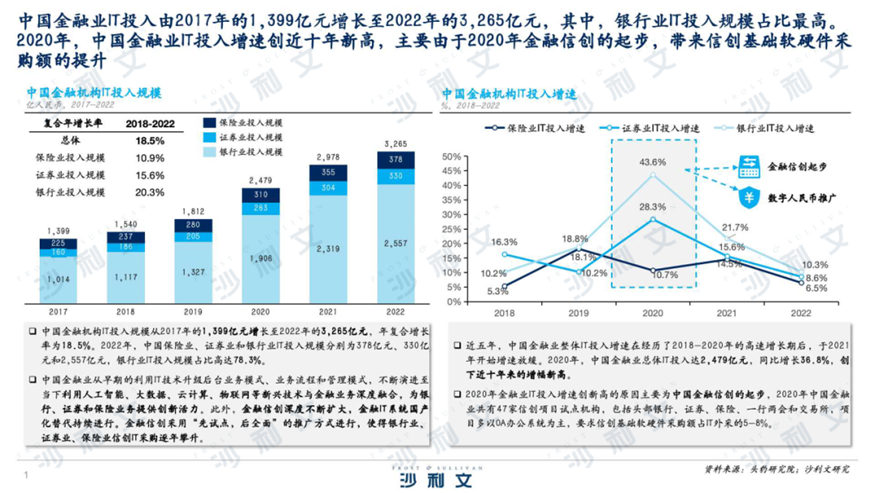
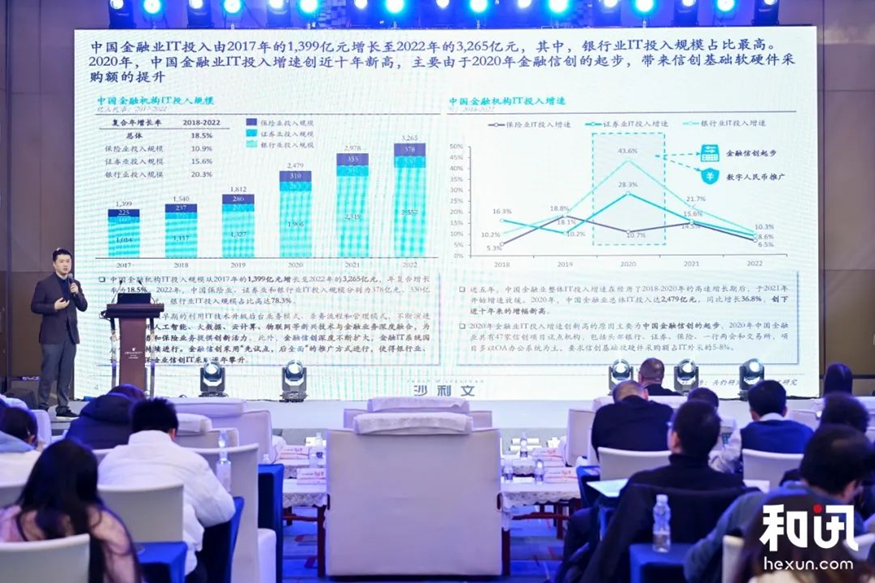
Wang Chenhui first shared about financeITThe current development status and trends. He pointed out that Chinese financial institutionsITThe scale of investment has shifted from2017year1,399RMB billion growth to2022year3,265Yuan, with an annual compound growth rate of18.5%.2022In [year], China's insurance, securities, and banking industriesITThe investment scales are as follows:378yuan,330yuan2,557yuan, banking industryITThe proportion of invested scale is as high as78.3%.
The early utilization ofITThe backend business model, processes, and management models are being upgraded technologically, evolving continuously to the current state where emerging technologies such as artificial intelligence, big data, cloud computing, and the Internet of Things are deeply integrated with financial services, providing innovative vitality for banking, securities, and insurance businesses. In addition, the depth of financial innovation and entrepreneurship continues to expand, with financeITThe system localization replacement is ongoing. The financial industry's fintech adoption follows a 'pilot first, then full rollout' approach, enabling fintech innovation in the banking, securities, and insurance sectors.ITPurchases have been climbing year by year.
In the past five years, the overall financial industry in ChinaITThe growth rate of capital investment has experienced2018 - 2020After a period of rapid growth in2021The growth rate began to slow down at the beginning of the year.2020In [year], the overall financial industry in ChinaITInput reaches2,479Yuan, a year-on-year increase36.8%, hitting a new high in growth rate in nearly a decade.
2020Annual Financial IndustryITThe reason for the record high in investment growth is mainly due to the start of financial innovation-driven development in China.2020In China, the financial industry in47Pilot institutions for the Home Credit Innovation Project include leading banks, securities firms, insurance companies, regulatory authorities, and exchanges. The projects mostly involveOAThe office system is the main focus, requiring that the procurement amount of information technology innovation basic software and hardware accounts forITprocured externally5 - 8%.
At the policy level, just2021Year-end2023In [year], the state level promulgated a series of policies aimed at promoting the integrated development of artificial intelligence, blockchain, big data, cloud computing, and other technologies with financial services, and accelerating the digital transformation process of the banking, securities, and insurance industries.
During the "14th Five-Year Plan" period, China's digital economy has entered a new stage of deepening application, standardized development, and inclusive sharing.2022In [year], in the face of new downward economic pressures, China's digital economy scale reached50.2trillion yuan, still up year-on-year4.68trillion yuan. Digital economy accounts forGDPThe proportion further increased, reaching41.5%At the same time, the 14th Five-Year Plan clearly states: Develop fintech steadily and accelerate the digital transformation of financial institutions. Wang Chenhui pointed out that driven by factors at the customer, management, and competition levels, institutions in the banking, securities, and insurance sectors have been increasing their effortsITInvest to achieve business innovation and upgrading.
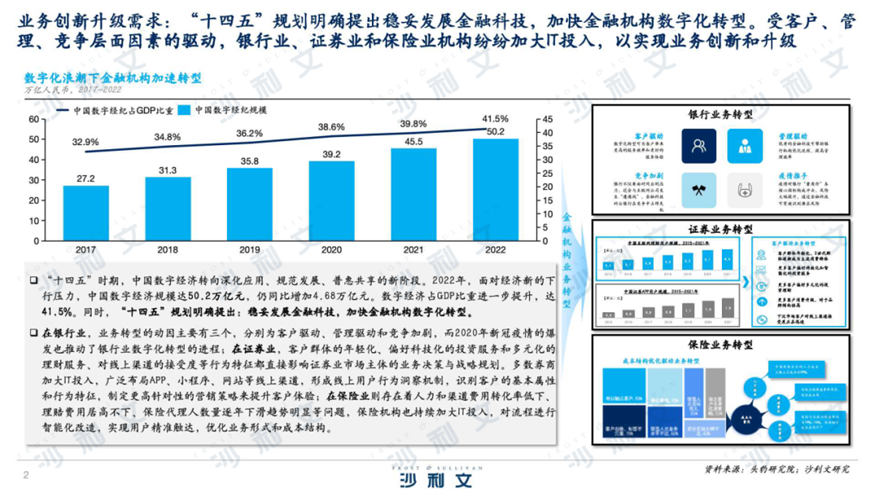
"The 14th Five-Year Plan “2035The 'Visionary Goals Outline' proposes that implementing a financial security strategy will be one of the key directions for ensuring national economic security. It is necessary to advance the security and controllability of core information technology in the financial industry and maintain the safety of financial infrastructure. With the continuous promotion of financial innovation, banks, securities firms, and insurance institutions all plan to increase their investment in innovation-driven technologies.ITInvest to achieve autonomous and controllable security of underlying software and hardware infrastructure.2022In [year], while the third phase of financial innovation pilot projects was launched, the industry also entered a stage of comprehensive promotion. The number of participating banks, insurance companies, and securities institutions will also increase to4,601home,238Family137home.
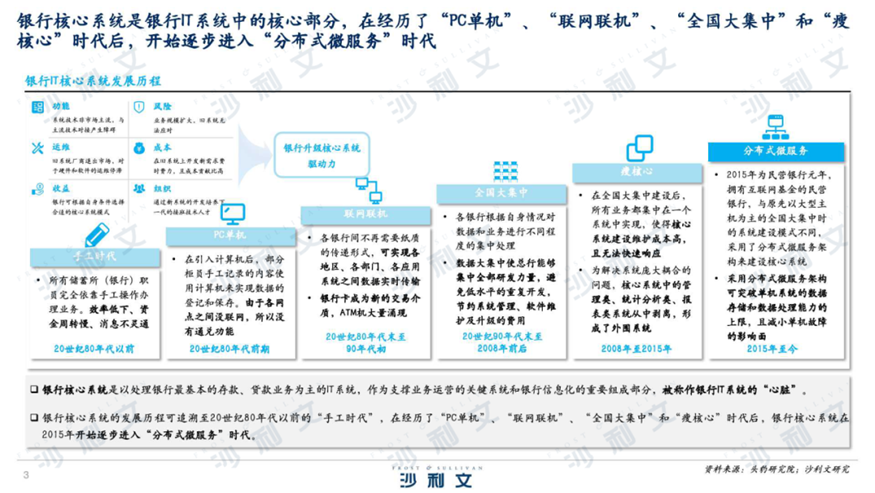
In the banking sector, Wang Chenhui introduced that the bank's core system mainly handles the bank's most basic deposit and loan operationsITThe system, as a key system supporting business operations and an important part of bank informatization, is referred to as the bankITThe system's 'heart'. The development history of the bank's core system can be traced back to20century80In the era before the Internet, the "Manual Era", after going throughPCAfter the era of stand-alone, online, nationwide centralized, and thin-core, banks' core systems are in2015The year began to gradually enter the era of "distributed microservices".
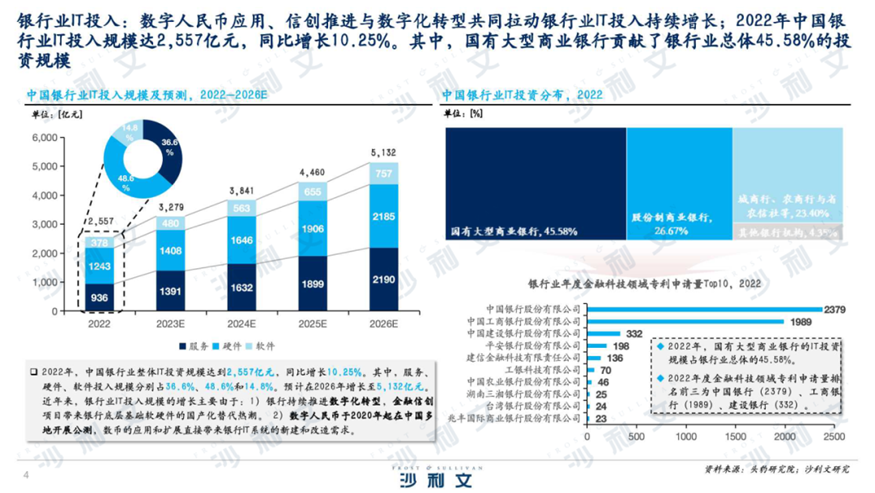
According to a study by Frost & Sullivan,2022In [year], the overall Chinese banking industryITThe investment scale has reached2,557Yuan, a year-on-year increase10.25%Among them, the investment scale in services, hardware, and software accounts for36.6%,48.6%and14.8%It is expected that in2026Year-on-year growth to5,132yuan. In recent years, the banking industryITThe growth in investment scale is mainly due to:1The bank continues to advance digital transformation, and financial innovation projects have sparked a wave of domestic substitution for the bank's underlying infrastructure software and hardware.2) The digital RMB was launched on2020In [start year], public beta tests were launched in multiple regions of China. The application and expansion of digital coins directly brought aboutITNew construction and renovation needs of the system.
Data shows, Bank of ChinaITThe market scale of solutions is2019year307.2RMB billion growth to2022year545.8Yuan, with an annual compound growth rate of21.1%It is expected that the market size will be in2027Year-on-year growth to1230.6yuan,2022 - 2027Annual compound growth rate17.7%. Wang Chenhui pointed out, in the future5The main drivers of market growth this year are due to the new development opportunities brought by emerging technologies to the banking industry under the backdrop of digital transformation, as well as the advancement of financial innovation and digital transformation, which has led to a new round of domestic substitution of software and hardware.
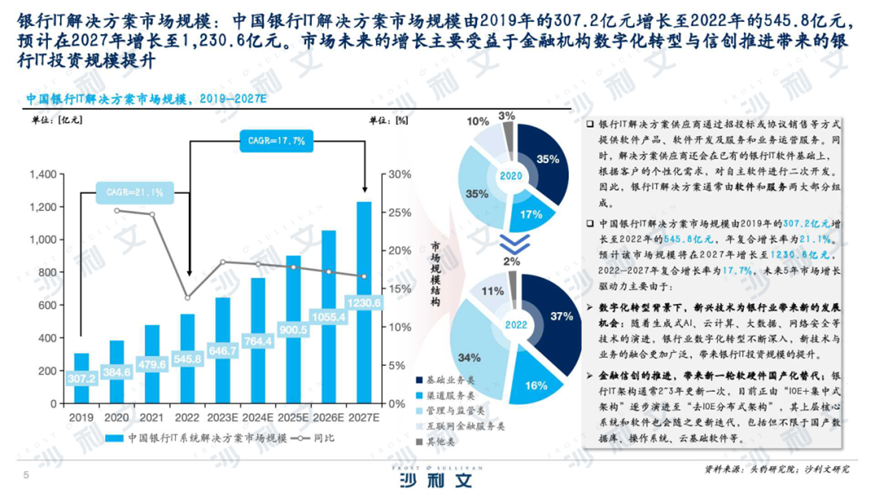
"Looking at the entire bankIT"The development trend is that in the future, at the technology end, emerging technologies represented by artificial intelligence, big data, cloud computing, blockchain, etc., will accelerate their integration with banking services and continue to penetrate into small and medium-sized banks; on the industrial side, banks will continuously broaden the breadth and depth of their business cooperation with outsourcing service providers, shifting from single-service provision to strategic cooperation." said Wang Chenhui.
Subsequently, Wang Chenhui sharedAIThe application of large models in the financial industry. He stated that the integration of large models with financial data has become an important driving force for the innovation and development of financial technology. Through the application of technologies such as data, information, and artificial intelligence, the financial industry is witnessing innovative breakthroughs, achieving comprehensive empowerment and sustainable development.
The commercial value brought by China's financial large models is reflected in solving complex problems, providing personalized financial services, strengthening risk management, and preventing financial fraud. It creates more development opportunities for the fintech industry, enhancing service quality and operational efficiency. Wang Chenhui further explained that large models can solve complex financial problems, such as improving service quality through more accurate credit scoring, refined risk management, and personalized financial services. Personalized financial services are an important development direction in financial services. With the support of large models, personalized financial services are no longer an unattainable dream but a goal that is getting closer to reality.
Risk management plays a central role in fintech and is a key area for the application of big data and artificial intelligence. Traditional risk assessment methods often rely on simplified models and limited data, but such methods often struggle with complex financial risks. Large models have powerful data processing capabilities that can analyze large amounts of complex transaction data, thereby capturing subtle signals of risk. In the fight against financial fraud, large models can identify abnormal transaction patterns through deep learning, providing more accurate fraud prevention. Their continuous learning ability adapts to changes in fraud methods, effectively protecting the interests of financial institutions and users.

"Overall, large models have provided powerful tools and methods for financial technology in preventing financial fraud, bringing about significant opportunities," said Wang Chenhui.
In the field of artificial intelligence, under the trend of digital transformation, the financial technology investment of the six major state-owned banks has increased year-on-year11.26%, and at the same time, generativeAIThe application rate in the banking industry is gradually increasing. Its application in the banking industry can span all business processes to achieve cost reduction and efficiency improvement.AIGCEmpowering product R&D, channel marketing, operation management, customer service and other aspects, promoting the digital and intelligent transformation of the insurance industry. At present, the insurance industryAIGCLimited training levels and practical depth of large models, insuranceITThe market potential remains untapped; AI-powered securities businessITOne of the important directions of investment, generativeAIThe impact on the securities industry mainly lies in cost reduction and efficiency improvement, as well as enhancing customer stickiness. It can be applied in scenarios such as risk assessment, investment decision-making, intelligent trading, and intelligent customer service.
Wang Chenhui concluded that financial large models face challenges in data, computing power, industrial policies, and industry regulation. They need to address issues such as data quality, computing power innovation, and policy norms to ensure the security and sustainable development of the technology.
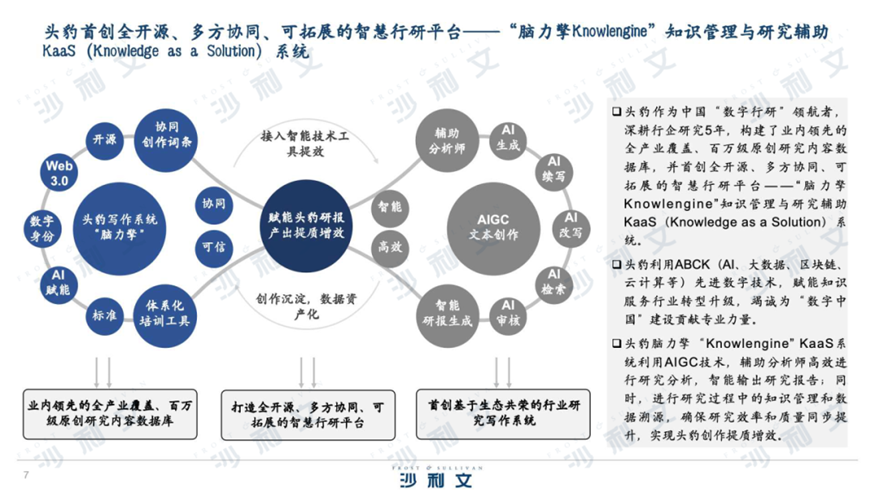
Finally, Wang Chenhui briefly introduced to the guests present 'LeadLeo', an open-source, multi-party collaborative, and scalable AI-driven research platform - 'BrainPowerStack'.Knowlengine"Knowledge Management and Research Assistance"KaaS(Knowledge as a Solutionsystem, which utilizesAIGCTechnology assists analysts in conducting research and analysis efficiently, intelligently generating research reports. At the same time, it manages knowledge during the research process and traces data to ensure that research efficiency and quality are improved simultaneously, achieving quality improvement and efficiency enhancement through LeadLeo's creation.